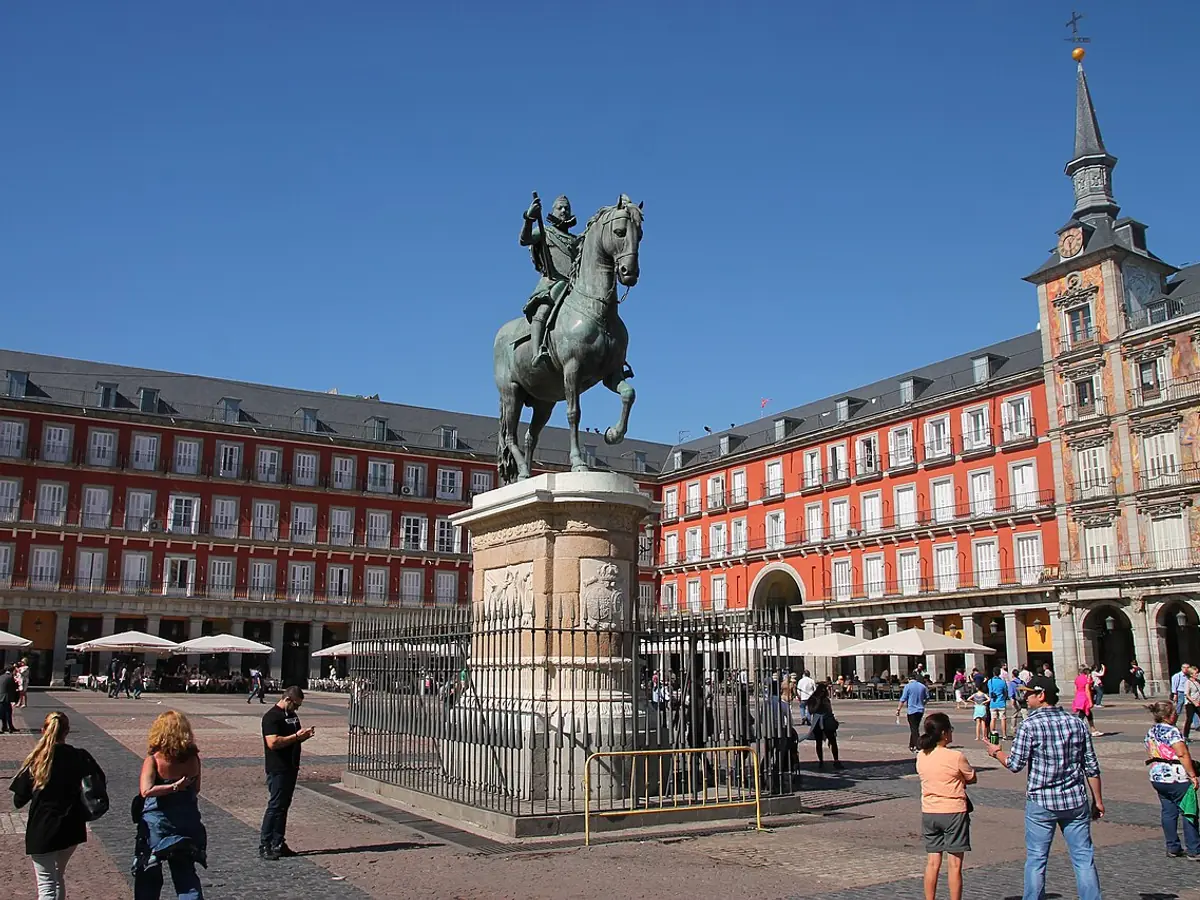
Plaza Mayor, Madrid
Plaza Mayor is Madrid’s principal public square, enclosed by residential buildings and arcaded walkways. Its story reaches back to the sixteenth century, when this site held the city’s main market beyond the medieval town. The present square took shape between 1580 and 1619, during the reign of Felipe III, with work directed by Juan Gómez de Mora after plans by Juan de Herrera.
Look toward the building on the northern side: the Casa de la Panadería carries a stone royal coat of arms, while mural decoration added in 1992 brings mythological figures, including Cibeles, across its façade. The square has three-storey buildings, 237 balconies, and ten entrances; the arches were part of Juan de Villanueva’s rebuilding after the fire of 1790. That blaze destroyed a third of the square, and the reconstruction continued until 1854.
At the square’s centre stands Felipe III on horseback. Juan de Bolonia began the sculpture and Pietro Tacca completed it in 1616. It reached this square in 1848, after previously standing in the Casa de Campo.
In 1931, an explosive hidden inside the hollow horse burst through its belly. The monument still gives this enclosed urban space its striking focal point.
.jpg)