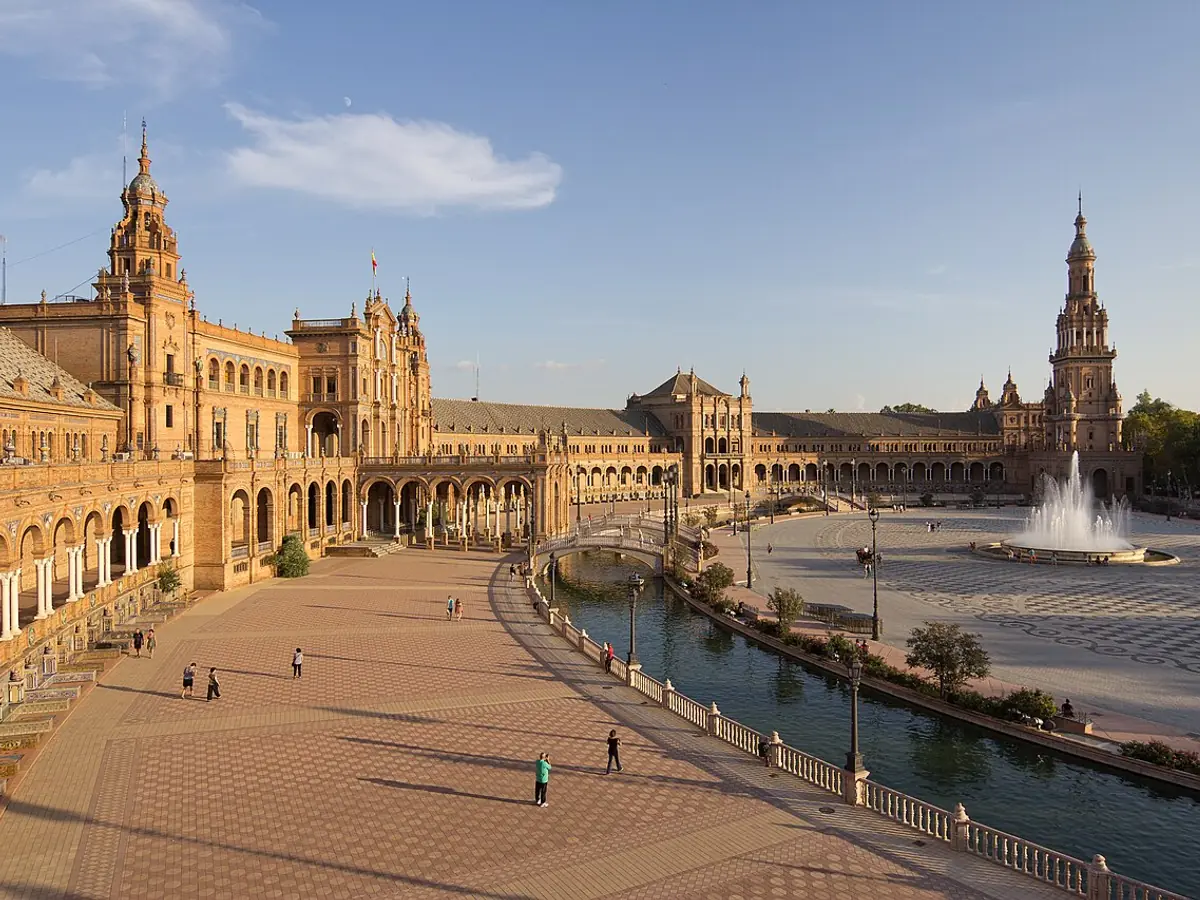
Plaza de España, Seville
Updated
Listen to how the story begins
0:00 / 0:45
Plaza de España opens before you as a vast semicircular architectural complex, wrapped around a tiled waterway and approached by bridges. Aníbal González designed it for the Ibero-American Exposition held in Seville in 1929, and construction took place from 1914 to 1929. The result combines Spanish Renaissance and Baroque revivals with Neo-Mudéjar detail, giving the buildings a richly layered character.
Look along the curved gallery and you can see tiled alcoves devoted to Spain’s provinces. Their ceramic benches, heraldic decoration, and covered bookshelves turn the walls into a place of memory as well as architecture. The complex has 48 provincial benches and 52 medallions honouring figures from Spanish history.
A canal crosses the open space, with four bridges symbolising ancient Spanish kingdoms, while the Vicente Traver fountain marks the plaza’s central axis. This is also a building with a cinematic afterlife: its setting appears in Lawrence of Arabia, Star Wars: Episode II – Attack of the Clones, The Dictator, and the series Kaos. Its original fabric was carefully renewed from 2007 to 2010, including ceramic lamps, benches, and paving. What you see is both an exhibition monument and a stage built in tile, water, and sweeping brickwork.
_-_01.jpg)