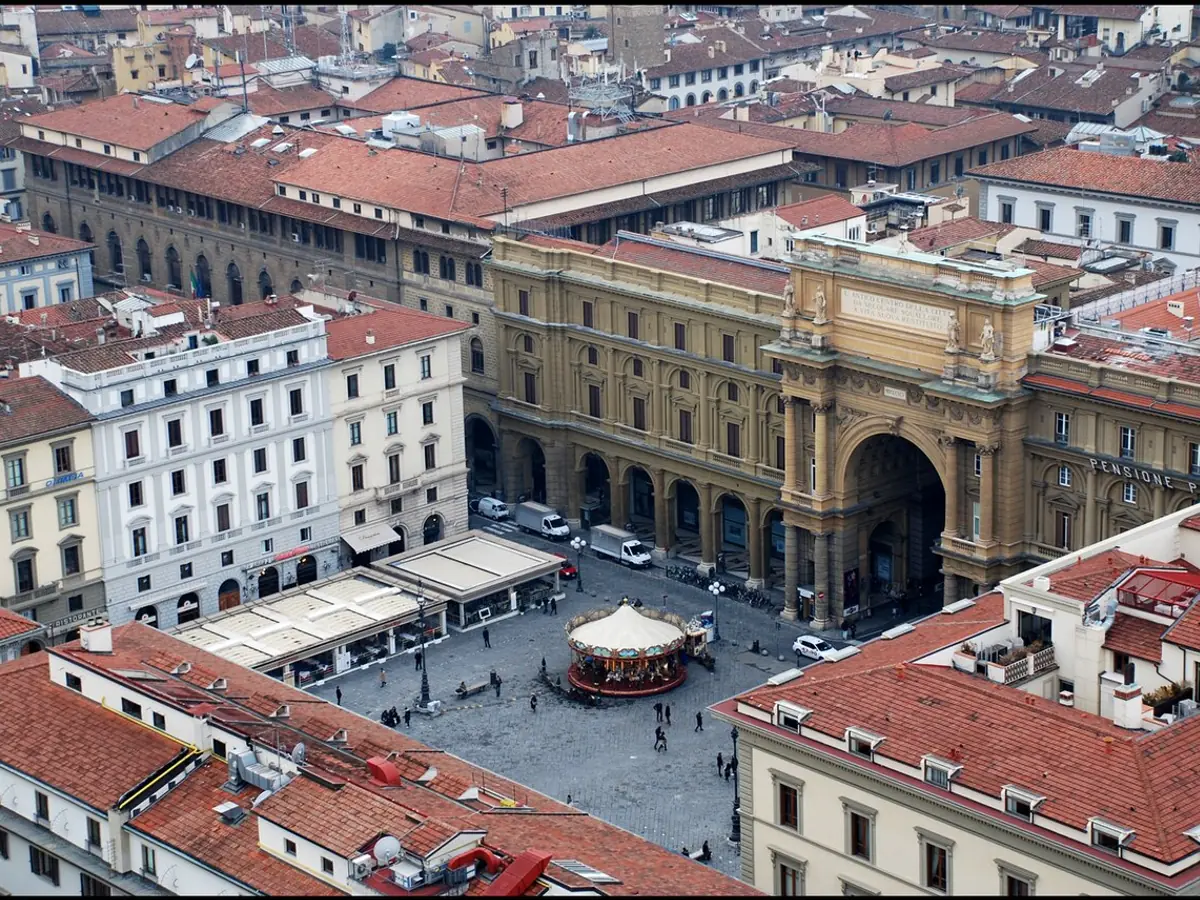
Piazza della Repubblica, Florence
Piazza della Repubblica is a broad rectangular square, about 75 m by 100 m, whose present form emerged from Florence’s nineteenth-century Risanamento works. The open space now occupies ground that once held the Roman forum, later the Mercato Vecchio and the Jewish ghetto. Look at the Colonna dell’Abbondanza, the surviving marker of that earlier marketplace.
It stands close to the ancient crossing of Florence’s main Roman streets; the column dates from 1431, and its present statue is a 1956 copy of Giovan Battista Foggini’s figure of Abundance. Foggini’s work had replaced an eroded sculpture attributed to Donatello. The broad arcaded entrance, known as the Arcone, belongs to the rebuilding that followed Florence’s period as capital of unified Italy.
Vincenzo Micheli designed it, drawing on courtly Renaissance forms. Its inscription presents the transformation as a return from long neglect to renewed life. Above it, an allegorical group once represented Italy, Art and Science, but deterioration led to its removal in 1904.
That rebuilding erased medieval towers, churches, guild buildings, aristocratic residences, workshops and homes. The new square then became a setting for elegant cafés, including Giubbe Rosse, where artists and writers—especially Futurists—met and argued.
.jpg)