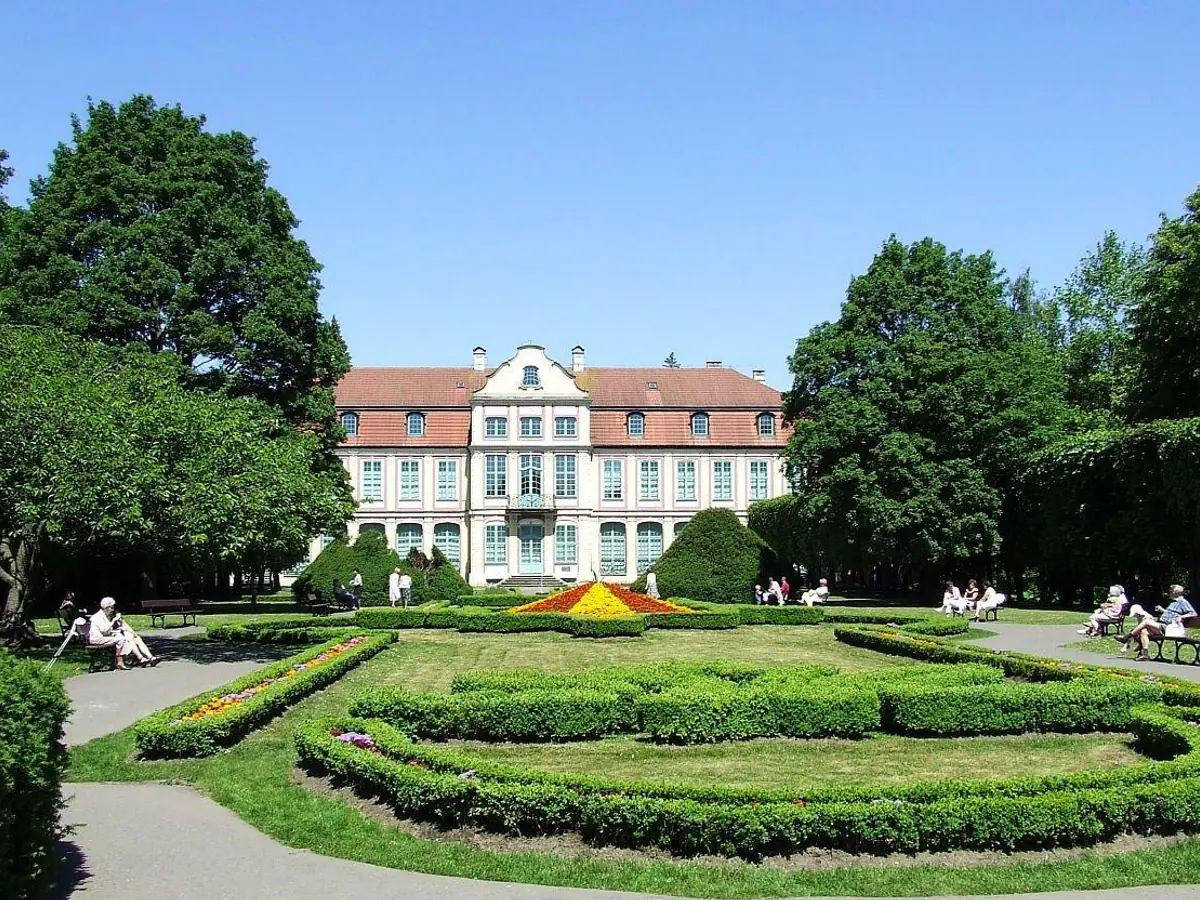
Park Oliwski im. Adama Mickiewicza, Gdańsk
Park Oliwski, named for Adam Mickiewicz, unfolds around you as a historic garden where monastic order meets deliberately composed scenery. It occupies eleven point three hectares beside the Oliwa Stream. This landscape began as a garden belonging to the Cistercian monastery.
Under Abbot Jacek Józef Rybiński, a gardener named Hentschel reshaped part of it in the Baroque manner, drawing on the grand garden designs of André Le Nôtre. Notice the long water basin and the Lime Avenue: their alignment creates a theatrical vista. At its far end, a tree-framed pond once produced an illusion that its water joined the distant Gulf of Gdańsk; growing trees now conceal the sea.
Elsewhere, the park changes character. Jan Jerzy Saltzmann designed winding paths and pools to imitate untamed nature, following fashionable ideas about Chinese gardens. The surviving artificial mounds and the cascade on the Oliwa Stream belong to this more playful landscape.
After the monastery was dissolved, the grounds became a public dendrological and landscape garden. War damage in nineteen forty-five was severe, yet the park was restored close to its earlier form and is now protected as a historic property.
Good for
Nature, History


.jpg)
More places in Gdańsk

itomasz przechlewski from Sopot, Poland (CC BY 2.0) Baszta Biała
history

iTomasz Sienicki [user: tsca, mail: tomasz.sienicki at gmail.com] (CC BY 3.0) Baszta Jacek
history

iGorwiu (CC BY-SA 3.0) Baszta Kotwiczników
history

iAndrzej Otrębski (CC BY-SA 4.0) Baszta Łabędź
history