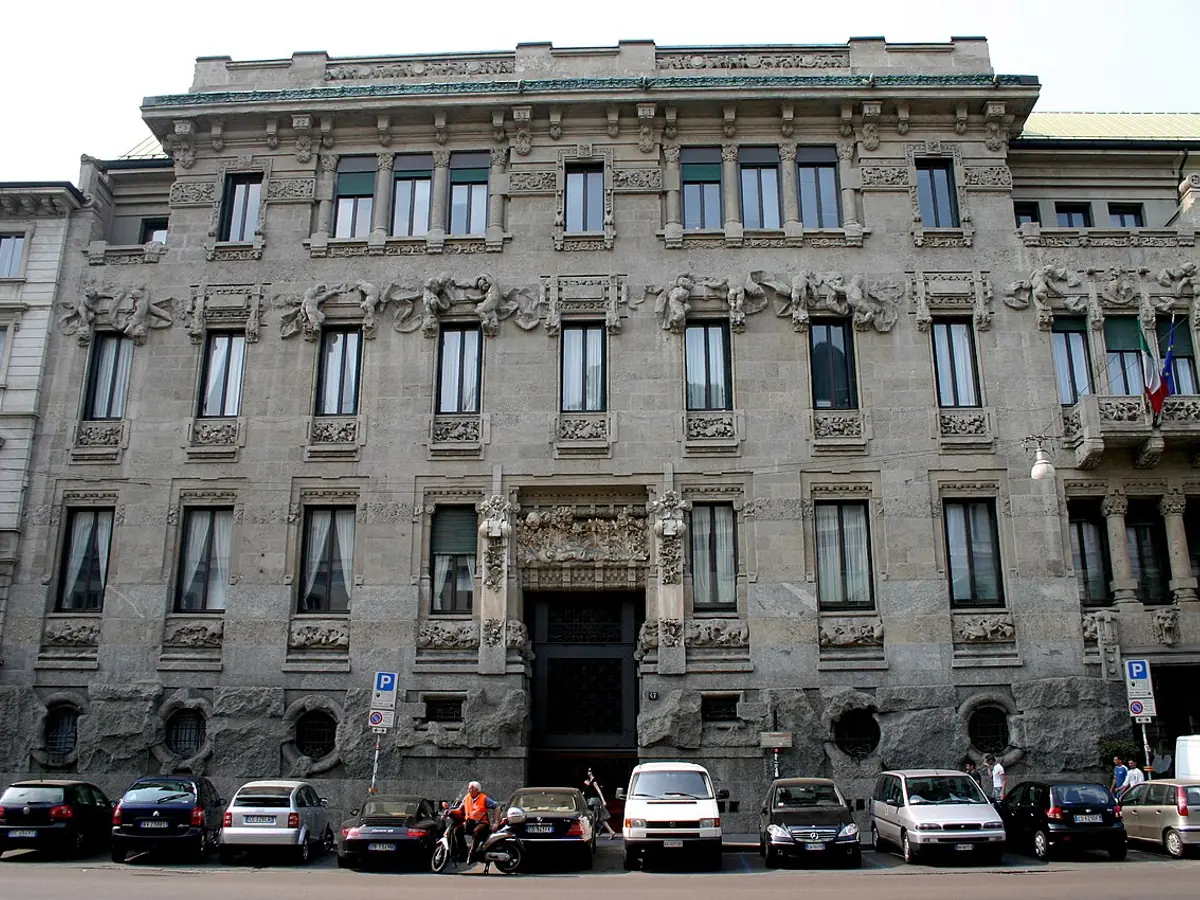
Palazzo Castiglioni, Milan
Palazzo Castiglioni is an Art Nouveau palace designed by Giuseppe Sommaruga, and its construction ran from 1901 to 1903. The building was commissioned by entrepreneur Ermengildo Castiglioni, who wanted a grand residence that would challenge Milan’s conservative architectural taste with a fashionable new language. Look at the rough stonework across the basement: its blocks are shaped to suggest natural rock.
Above that texture, the decoration draws on the elaborate stucco traditions of the eighteenth century. Sommaruga’s approach was deliberately unconventional, and the palace became a powerful expression of its owner’s wealth and ambition. Its most scandalous feature has disappeared.
Ernesto Bazzaro created nude female figures for the façade, intended as symbols of Peace and Industry. Their appearance caused such an uproar that they were removed; Milanese people mocked the building with the nickname Cà di ciapp, meaning “house of buttocks.” The statues now decorate Villa Romeo Faccanoni, another Milanese work by Sommaruga.
The interior also carries a dramatic history: occupying US troops burned the furniture as fuel during 1945 and 1946, while the decorative elements, ironwork, and lamps survived. Since 1967, the palace has housed the Unione Commercianti di Milano, the city’s Traders’ Union.
_-_Foto_Giovanni_Dall%27Orto_22-Apr-2007.jpg)