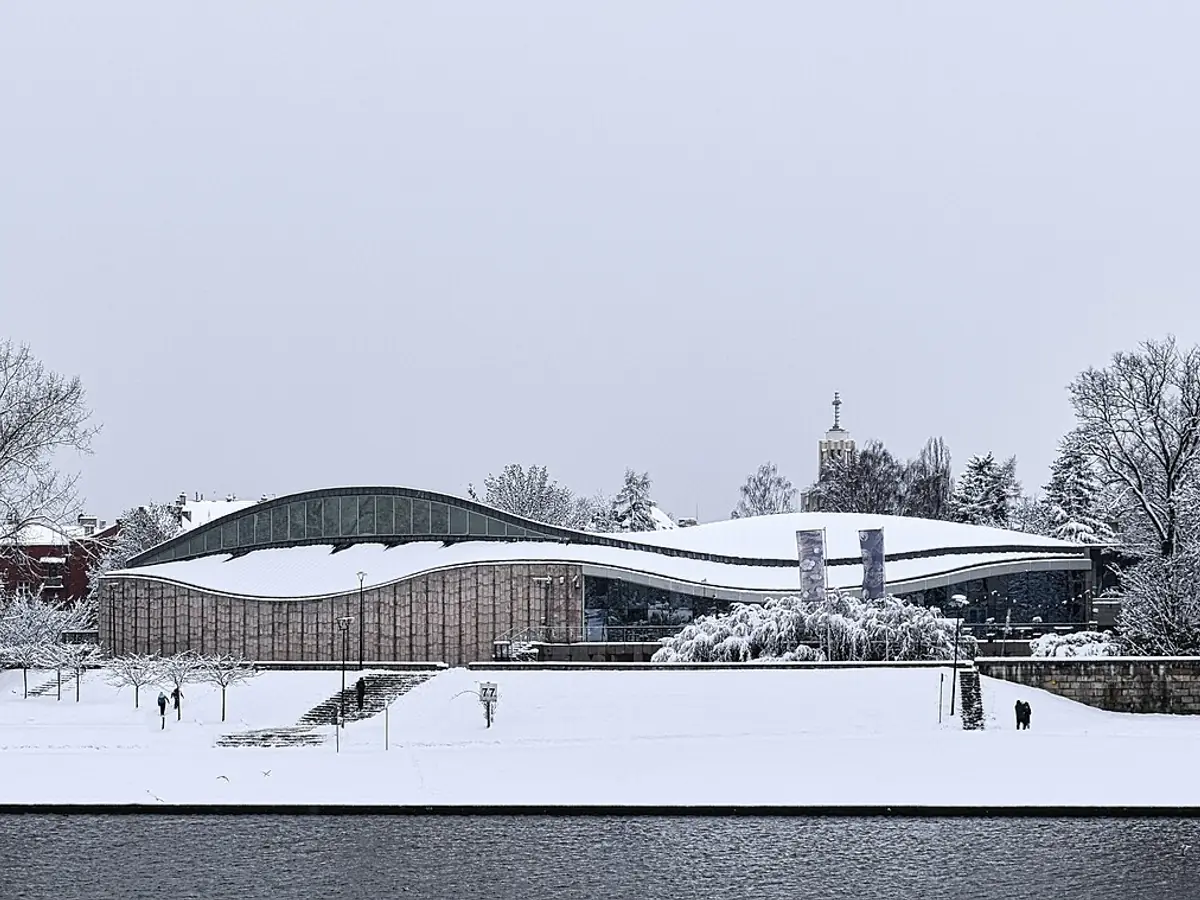
Muzeum Sztuki i Techniki Japońskiej Manggha, Kraków
Updated
Listen to how the story begins
0:00 / 0:45
Manggha, Kraków’s Museum of Japanese Art and Technology, is the modern museum before you, its broad roof shaped to evoke the sea in traditional Japanese painting. Its story begins with Feliks Jasieński, a critic, writer and collector who used “Manggha” as his pen name. In 1920 he gave the National Museum in Kraków his Japanese-related art collection, but after his death more than 6,500 objects largely remained out of public view because there was not enough room.
One visitor to the collection’s 1944 display in the Cloth Hall was nineteen-year-old Andrzej Wajda; Japanese art captivated him. When Wajda received the Kyoto Prize in 1987, he devoted the entire award to creating a building for Jasieński’s collection. Japanese architect Arata Isozaki supplied the design as a gift, working with Polish collaborators, and the centre opened on the thirtieth of November 1994.
The garden beside the museum came from Kyoto. In 2002, Emperor Akihito and Empress Michiko visited; selected woodblock prints by Utagawa Hiroshige were assembled for the occasion, and the couple gave audiovisual equipment for the Japanese-language school. Manggha now brings Japanese art, culture and technology into Kraków through exhibitions and classes, from tea preparation and flower arranging to language study.