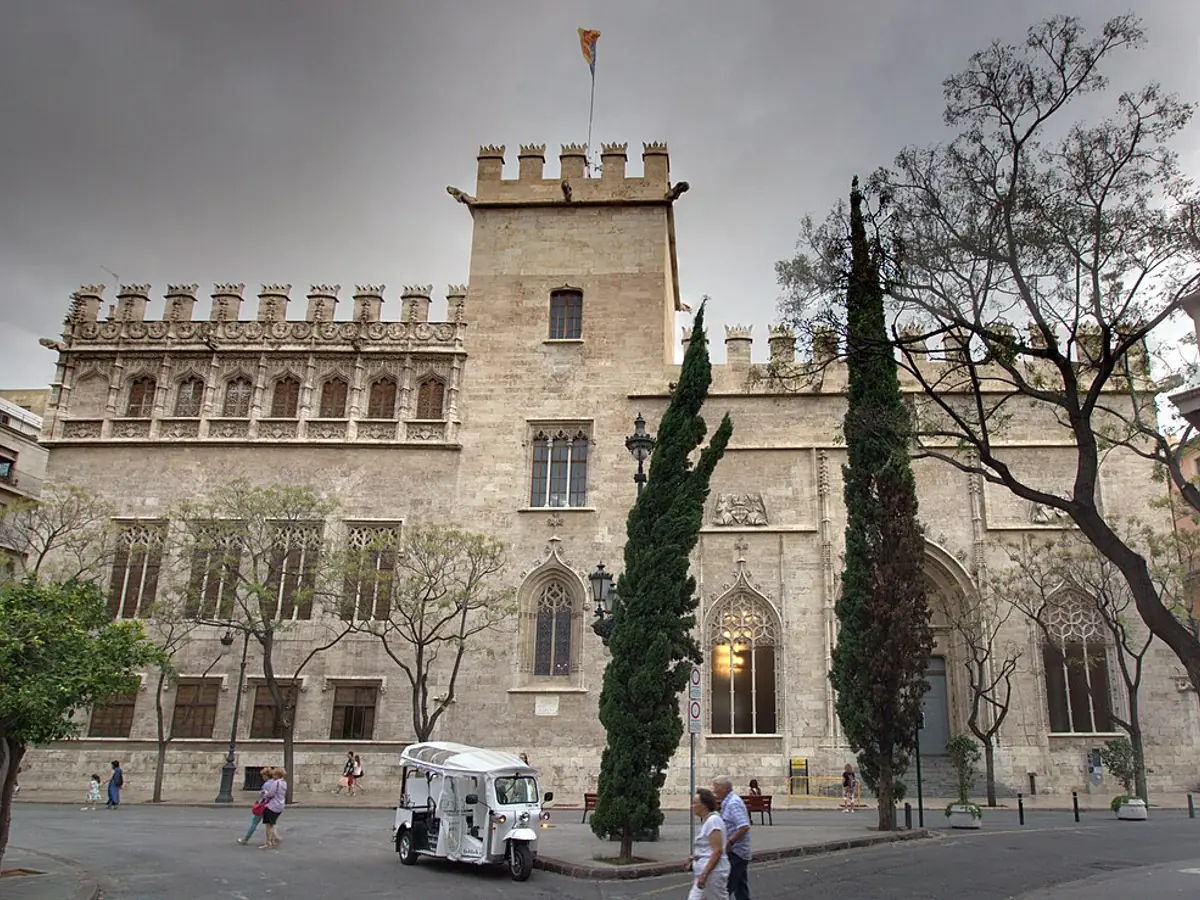
Llotja de la Seda, Valencia
The Llotja de la Seda is a civil building where Valencia’s merchants once arranged their business, and its stonework still gives that commercial purpose a powerful setting. Built between 1482 and 1533, it belongs to Valencian Gothic architecture and was designed by Pere Compte. Look at the Trading Hall, where twisted columns rise through the spacious interior.
This was the financial hub of the complex, the place where merchants negotiated contracts. A band running around the hall carries an inscription praising honest dealing, linking commercial success with ethical conduct. The building also includes the Consulate Pavilion, which housed the Consolat del Mar, Spain’s earliest marine merchant tribunal.
Its rooms preserve their original furnishings, while the central tower once served as a prison for merchants who could not pay their debts. An earlier oil market stood behind this building; silk was already traded there in 1348. The complex later served as a silk exchange, and UNESCO recognised it as a World Heritage Site in 1996. The walled Orange Garden completes the ensemble, giving this celebrated place of trade a quieter architectural setting.