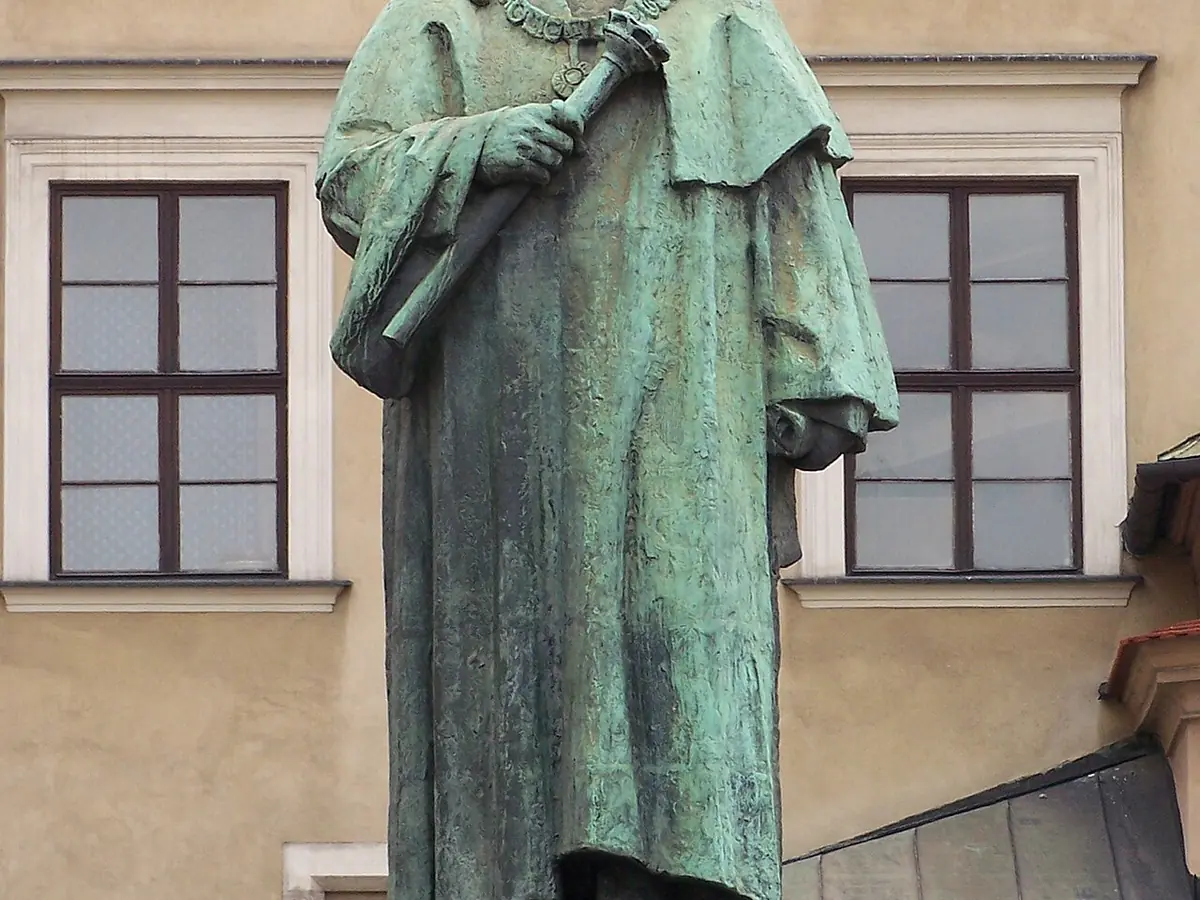
Józef Dietl, Kraków
Updated
Listen to how the story begins
0:00 / 0:45
This is the bronze monument to Józef Dietl, placed on All Saints’ Square before Kraków’s City Hall. Sculptor Xawery Dunikowski shows him standing in the ceremonial robe of the Jagiellonian University rector, a sceptre in his hand. Dietl was not simply an academic in costume: he transformed nineteenth-century medicine.
Born near Sambor in 1804 to an Austrian father and a Polish mother, he trained in Lviv and Vienna, then became a professor at the Jagiellonian University and its rector in 1861. He helped establish balneology, the medical use of mineral waters and therapeutic baths. His most consequential challenge was to bloodletting.
Through experiments using comparison groups, Dietl proved that the practice brought no benefit and could cause harm—an approach that anticipates the controlled clinical trials central to modern evidence-based medicine. He also identified the kidney disorder later called Dietl’s crisis and set out its treatment. Kraków elected this physician mayor for eight years, from 1866 to 1874.
The monument was cast in Warsaw in 1936 and unveiled on the eighth of October 1938, exactly sixty years after Dietl’s death. Dunikowski tested a model in Kraków’s different squares before selecting this site.