Galleria Sciarra, Rome
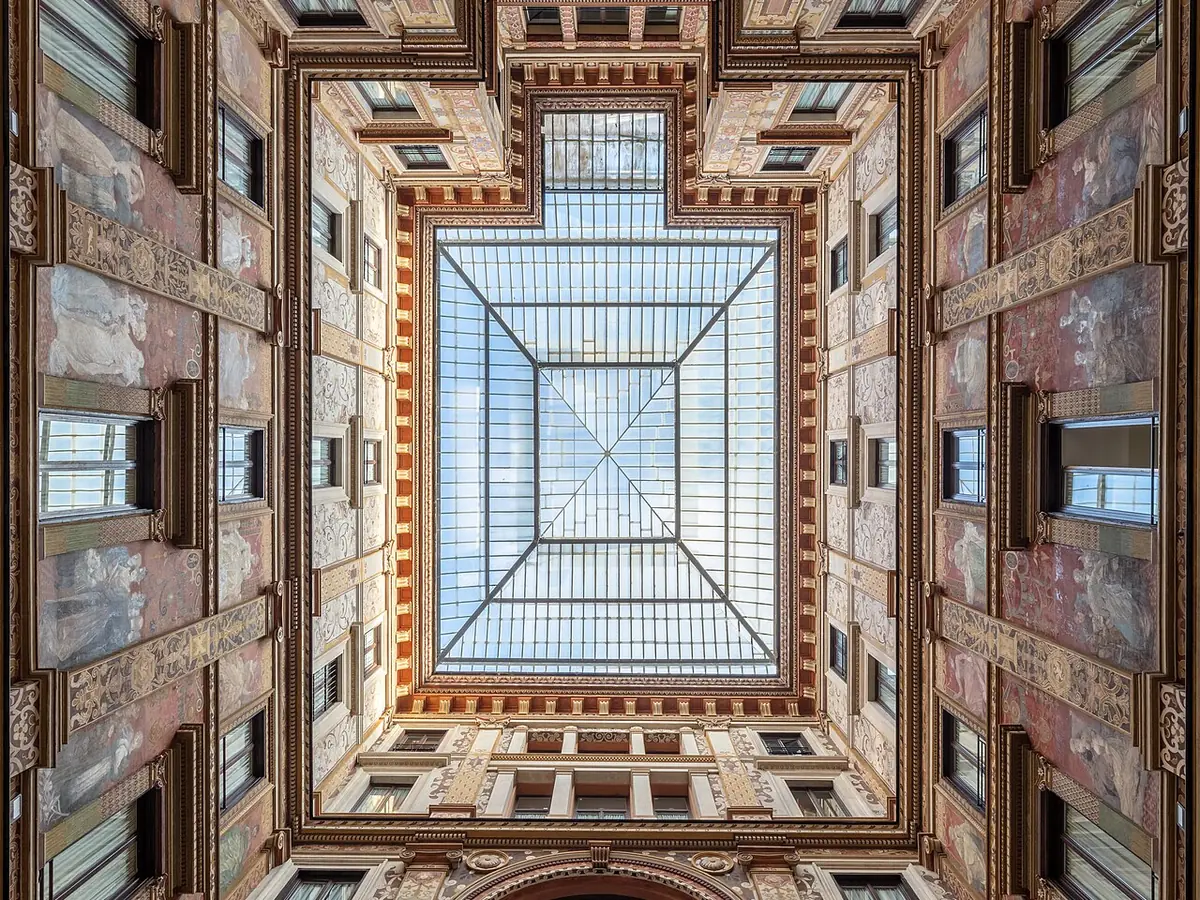
Galleria Sciarra is a covered pedestrian passage arranged around a courtyard, with a glass roof and delicate cast-iron supports. Its walls carry an elaborate painted programme created by Giuseppe Cellini between 1885 and 1888, under the guidance of literary critic Giulio Salvadori. The subject is an idealised celebration of womanhood, presented through figures representing modesty, restraint, humility, prudence, patience and kindness.
Scenes of domestic life appear below them, including childcare and a wedding, turning the passage into a picture of the household imagined by its age. Cellini used encaustic, a method in which pigment is mixed with wax, giving the decoration a distinctive material character. Look at the repeated initials woven into the ornament: they refer to Prince Maffeo Barberini-Colonna di Sciarra and his mother.
The prince commissioned the work, and architect Giulio De Angelis designed the structure. From 1886, it also served as a practical link between the prince’s residence and the offices of his newspaper, La Tribuna. The ironwork and paintings survived a major structural rebuilding in the late 1970s, so the passage still joins engineering, journalism and an intensely choreographed domestic ideal.