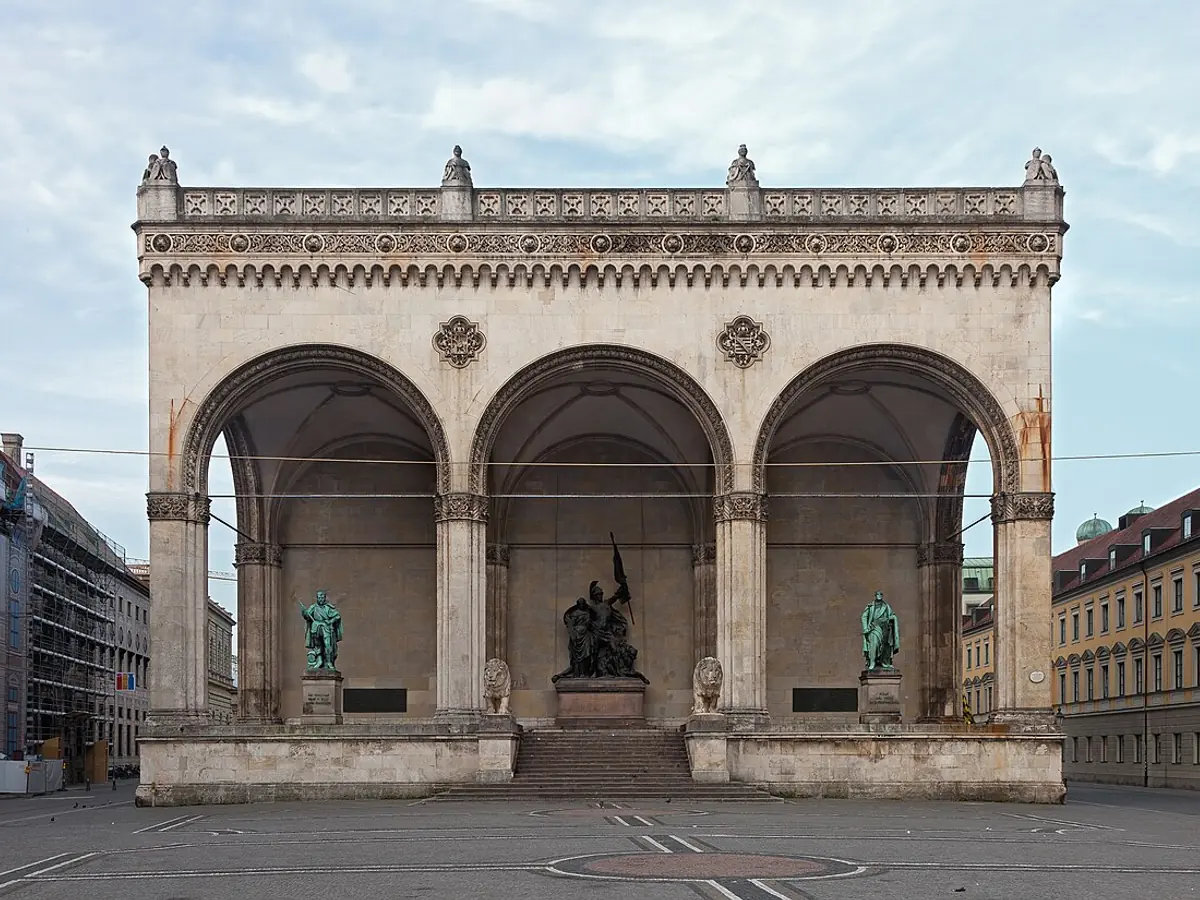
Feldherrnhalle, Munich
Feldherrnhalle is the monumental loggia opening onto Odeonsplatz, built as a Bavarian military memorial rather than as an ordinary passageway. Friedrich von Gärtner designed it for King Ludwig I, and construction ran from 1841 to 1844. Its form draws on Florence’s Loggia dei Lanzi, but Gärtner gave the Munich structure a more imposing effect by raising its broad stairway.
The hall honours the commanders Johann Tilly and Carl Philipp von Wrede with sculptures made by Ludwig von Schwanthaler. Under the arch nearer the Residenz, Tilly represents military leadership during the Thirty Years’ War; under the arch nearer the Theatinerkirche, Wrede recalls Bavaria’s change of alliance in 1813. Look at the sculpture group set against the rear wall: a warrior shields an allegorical figure of peace, while a resting lion and a lowered sword express the intended end of fighting.
Wilhelm von Rümann created the marble lions beside the stairs, which arrived in 1906. This place also carries a darker history. On the ninth of November 1923, a clash here between Bavarian police and Hitler’s followers ended the Beer Hall Putsch; four policemen and fifteen putschists died. After 1933, the Nazis turned the hall into a propaganda memorial, but that installation was removed in 1945.