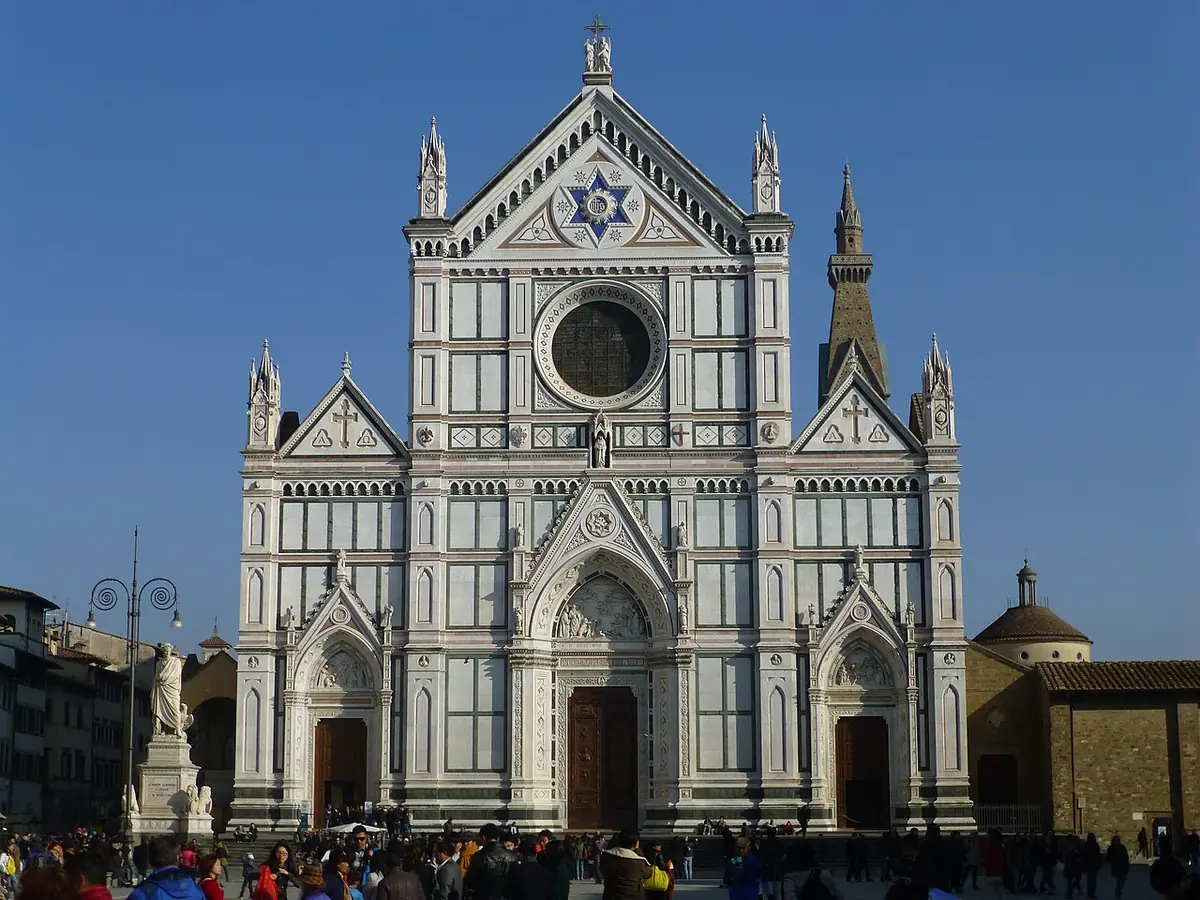
Basilica di Santa Croce, Florence
Santa Croce is the Franciscan basilica before you, dedicated to the True Cross. Its broad façade belongs to the nineteenth century: Niccolò Matas designed it, and its composition includes a Star of David. Matas was Jewish, and his burial place lies beneath the threshold, marked by an inscription.
The church’s creation began in 1294, to a design traditionally attributed to Arnolfo di Cambio. Its Gothic architecture unfolds through a vast interior with sixteen chapels, including spaces enriched by frescoes from Giotto and his pupils. The building is also a great place of memory: Michelangelo, Galileo, Machiavelli, Foscolo, and Rossini are among the figures buried or commemorated here, giving Santa Croce its reputation as the Temple of the Italian Glories.
The 1966 flood brought mud, pollution, and heating oil into the church, severely harming its art. Cimabue’s Crucifix was among the damaged works; it is now kept in the refectory. So the basilica you see is both a Franciscan church and a place where devotion, artistic achievement, national memory, and disaster remain visible together.