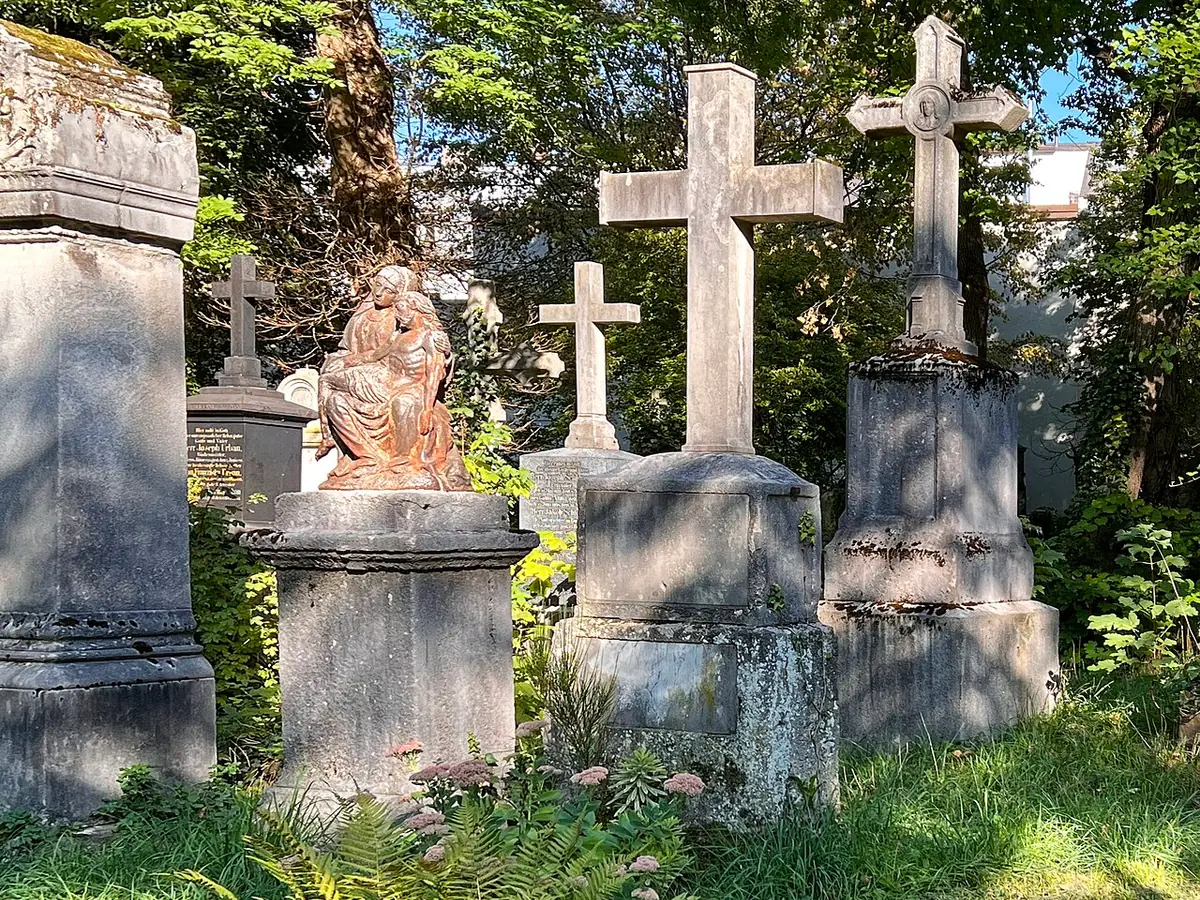
Alter Südlicher Friedhof, Munich
Alter Südfriedhof is a historic cemetery whose story begins during a plague emergency. Duke Albrecht V established it in 1563 beyond Munich’s former fortifications as a burial ground for plague victims. From 1788 to 1868, it served as the city’s sole general burial place, so its grounds bring together graves connected with many prominent Munich figures.
The site also holds the dead of the Sendling uprising of 1705, including 682 victims buried in communal graves in 1705 and 1706. The cemetery’s formal layout carries an architectural idea: Gustav Vorherr and garden designer Friedrich Ludwig von Sckell created the mortuary building and vaulted burial galleries from 1818 to 1821, with the overall plan shaped like a sarcophagus. The galleries gather people from different social ranks and occupations within one enclosure.
In burial field 6, the memorial fountain for the fallen of the uprising was unveiled on 1 November 1831. Friedrich von Gärtner designed it, and its metal form incorporates a sixteen-sided basin made from a melted-down cannon. The cemetery suffered severe wartime damage, then Hans Döllgast reshaped it in 1954 and 1955. Today, it functions as a public park and a monument to Munich’s artistic and cultural history.