
There is a particular photograph it is hard not to take in Porto: a church wall covered in blue and white tile. It reads instantly as old — as the kind of thing a city has simply always had. And the buildings underneath genuinely are old. Igreja do Carmo went up between 1756 and 1768. Igreja de Santo Ildefonso was completed in 1739. The chapel on Rua de Santa Catarina grew from an eighteenth-century foundation.
The tiles did not. Carmo's great side wall was produced in 1912. The chapel's blue exterior dates from 1929. Santo Ildefonso's façade panels were installed in 1932. Every one of these churches stood for well over a century before it was dressed in the ceramic you see today. What looks like the oldest thing about these buildings is very nearly the newest, and once you know it, the walk through Porto changes shape — you stop seeing a medieval city and start seeing an early-twentieth-century decision about how a city should look.
What follows are four stops that make that legible: three dressed in tile, and one where the granite itself is the performance.
The wall that started the habit
The Igreja do Carmo was built for the Carmelite Third Order, and its architect, José Figueiredo Seixas, worked in the rococo manner — lavish, animated decoration. That's the church itself, finished in 1768. Stand at the front and you can read its original intentions directly off the carving: Saint Anne, the church's patron, appears prominently on the carved façade, with Elijah and Elisha occupying niches beside the entrance. That carved front is the church speaking for itself; the tile belongs to the side wall.
Then walk around to the side, and the scale changes entirely. A vast tile tableau runs along the side wall, tracing the origins of the Carmelite Order and Mount Carmel. It postdates the church by almost a century and a half. Silvestre Silvestri designed it, Carlos Branco painted it, and workshops in Vila Nova de Gaia produced it — in 1912.
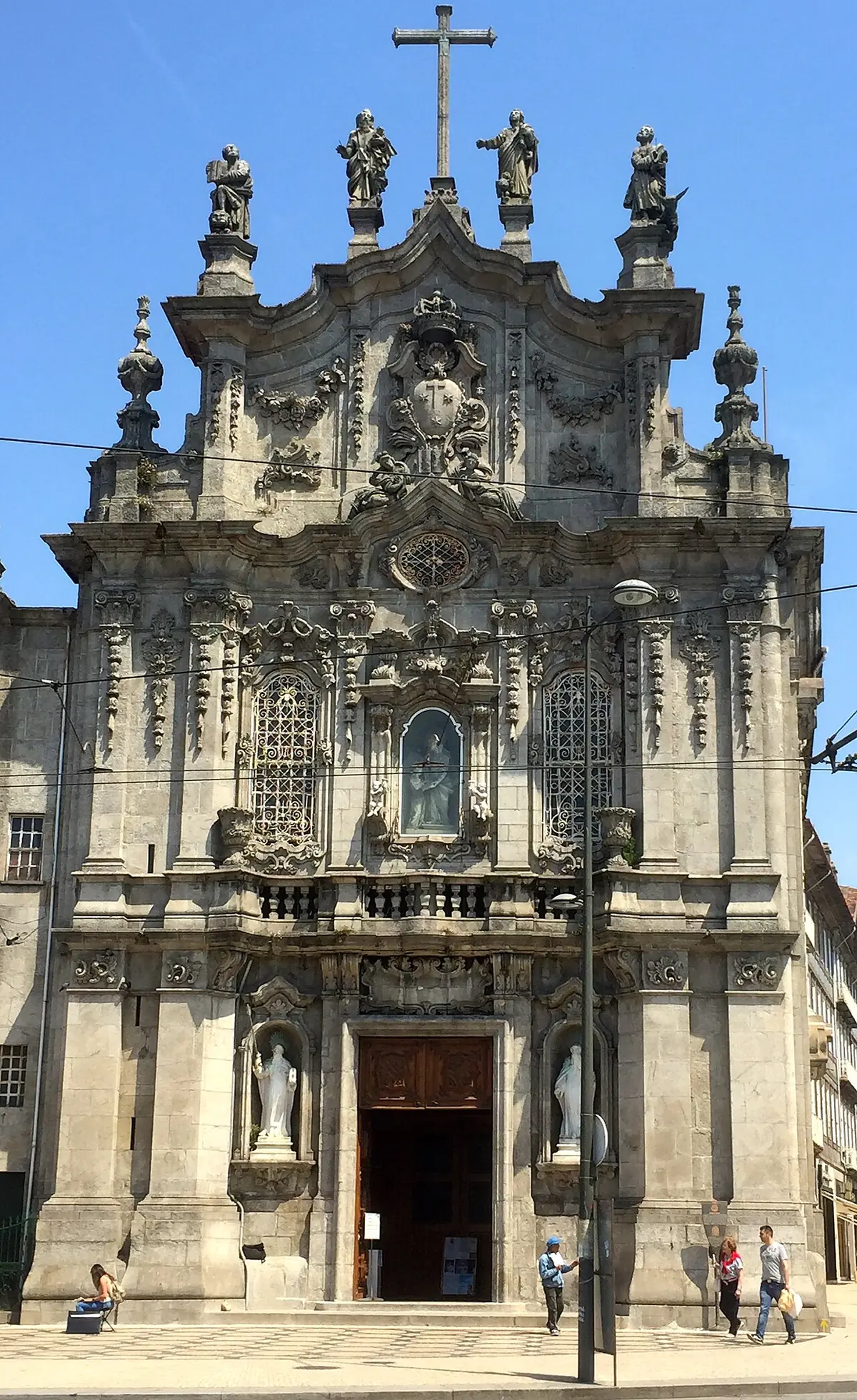
That gap matters for how you look at the wall. The tableau was not part of the church as it was built; it is a side elevation that somebody, much later, decided to treat as a canvas. The subject chosen was the order's own founding story, which means the tiles are doing something closer to what a stained glass window does than what decoration usually does — narrative, not ornament, at architectural scale on the outside of a building where passers-by rather than congregants would see it.
There is a second oddity here, easy to miss and worth looking for. Carmo does not stand alone: an adjoining Carmelite church sits immediately beside it, and the two became National Monuments together on 3 May 2013. Between them stands a remarkably narrow dwelling. It exists because regulations barred churches from being built directly against one another, so a sliver of domestic building was inserted to keep the two separate. The rule produced an architectural curiosity you can still look for today.
Fifteen thousand tiles on Rua de Santa Catarina
On Rua de Santa Catarina, the Chapel of Souls presents the same trick at a different scale. Also called Santa Catarina, the chapel is renowned for its tiled exterior, and the numbers are worth carrying with you: the blue tilework dates from 1929, and it runs to 15,947 tiles across roughly 360 square metres of wall.
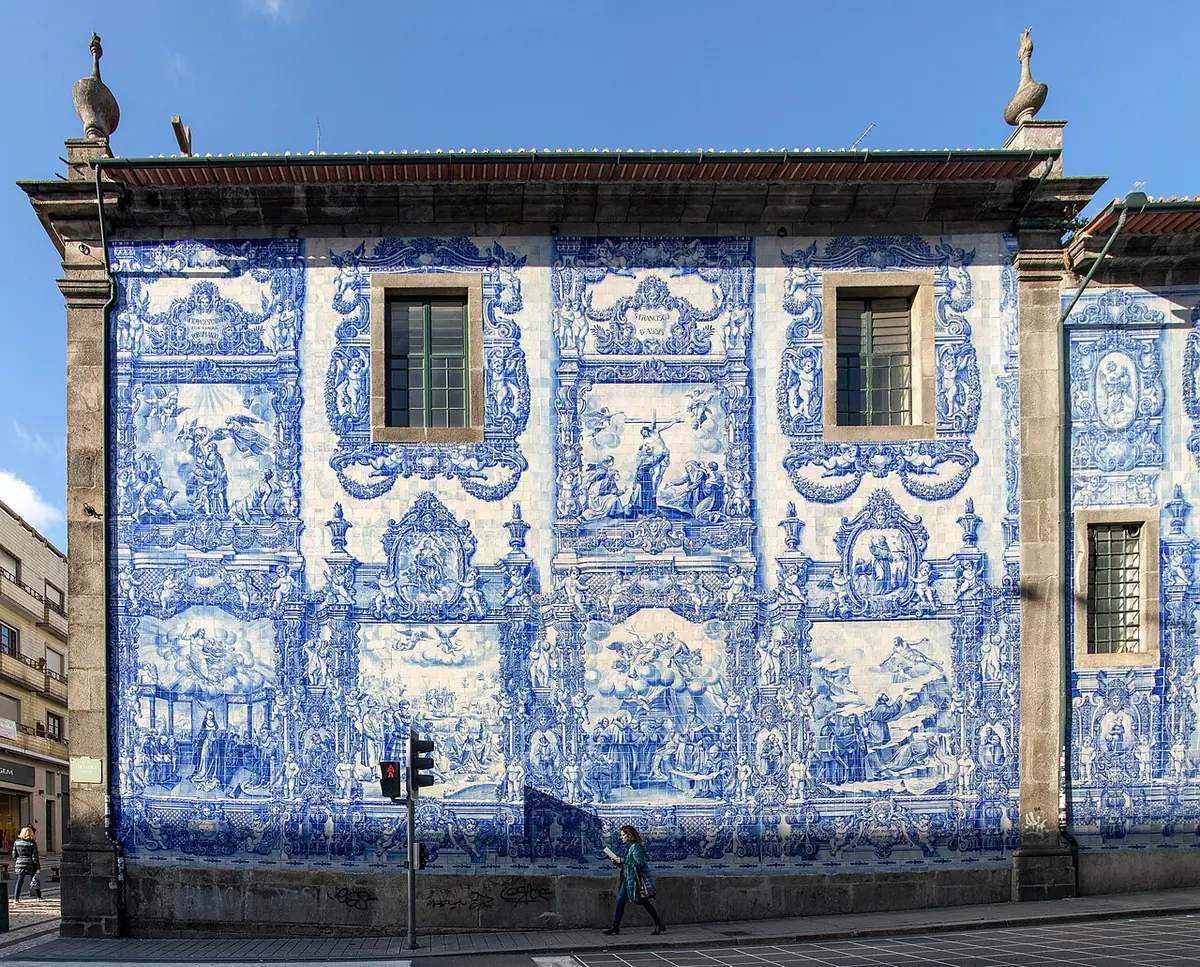

Eduardo Leite created the designs; a Lisbon ceramic factory produced the pieces. Along the façade the scenes recount episodes from the lives of Saint Francis of Assisi and Saint Catherine, whose veneration shapes the chapel's identity — the second name it goes by is not decorative. Notice how the repeated glazed squares turn sacred narrative into a vast public picture: the grid is doing the work that a frame does in a painting, breaking a continuous story into units small enough to manufacture and ship, then reassembling it on the wall.
The building beneath is older than the surface suggests. It grew out of an earlier timber shrine dedicated to Saint Catherine, and construction of the present chapel began late in the eighteenth century, after a Franciscan brotherhood relocated here from Santa Clara. So the sequence runs: a wooden shrine, then the present chapel, then — well over a century later — the ceramic skin that made it famous. The thing it is renowned for is the most recent layer.
Eleven thousand more, in 1932
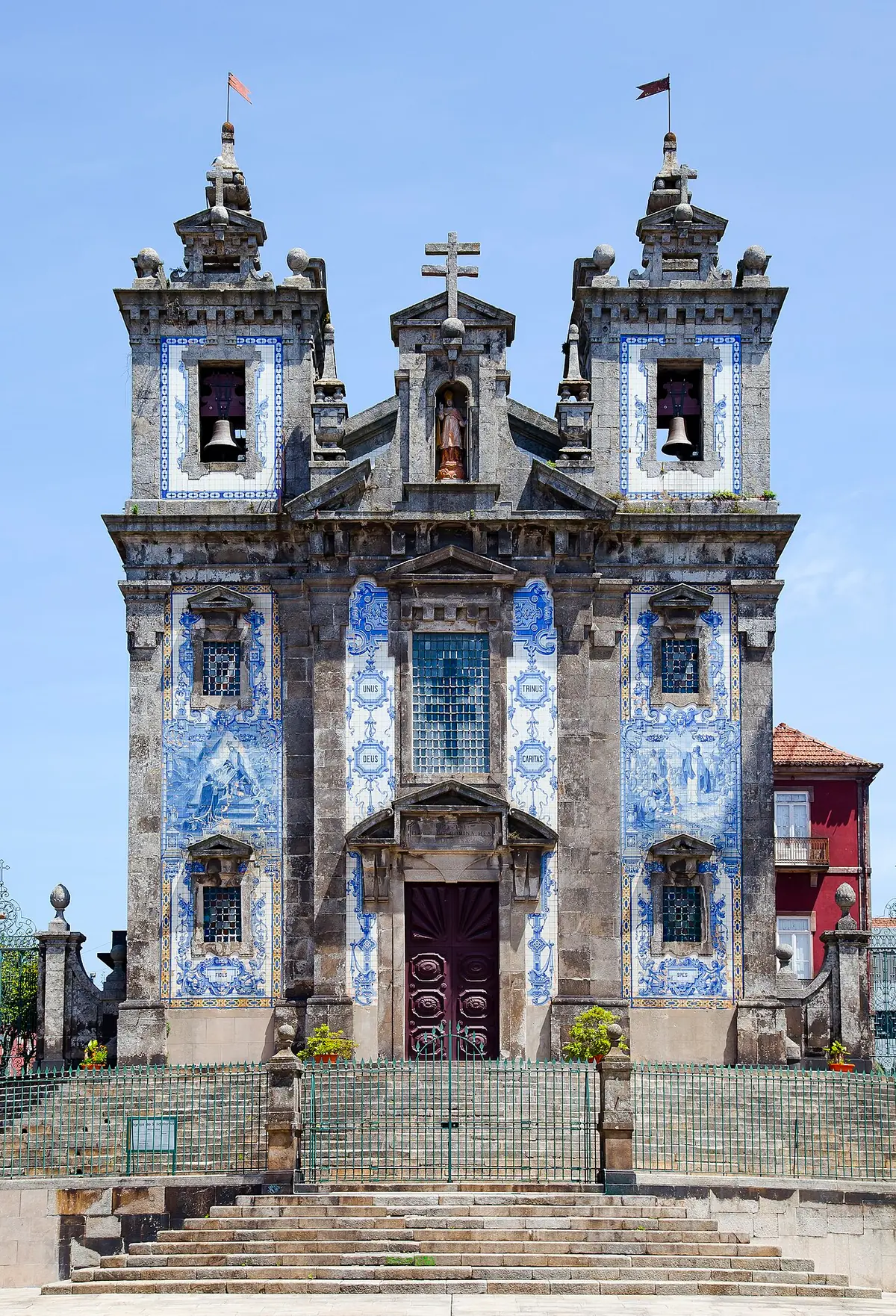
Beside Batalha Square stands Igreja de Santo Ildefonso, and it completes the pattern almost too neatly. The church is granite, completed in 1739, and it replaced an older chapel on the same site that had become dangerously unstable. Its façade now carries an extraordinary skin of painted ceramic panels — roughly 11,000 tiles by Jorge Colaço, installed in 1932.
Let your gaze travel across the blue and white scenes: they tell episodes from the life of Saint Ildefonso alongside images drawn from the Gospels. The church honours Ildefonso of Toledo, who served as bishop there from 657 until his death a decade later — a seventh-century Spanish cleric, commemorated on a Portuguese wall, in tiles laid between the world wars.

Inside, the building's older identity reasserts itself. The principal altarpiece was designed by Nicolau Nasoni, the architect behind the Clérigos ensemble you will meet at the last stop. And the church has taken real damage in its time: it has endured a violent storm and artillery fire during the siege of Porto. A later renovation of the entrance area turned up nineteen burials from the churchyard of the chapel that stood here before — a reminder that the site's story starts before 1739.
Three churches, then, all eighteenth-century, all tiled within a twenty-year window in the early twentieth. 1912, 1929, 1932. That is not a tradition stretching back to the founding of the city. That is a specific generation making a specific choice about how Porto should present itself, and doing it three times within living memory of one another.
The granite underneath
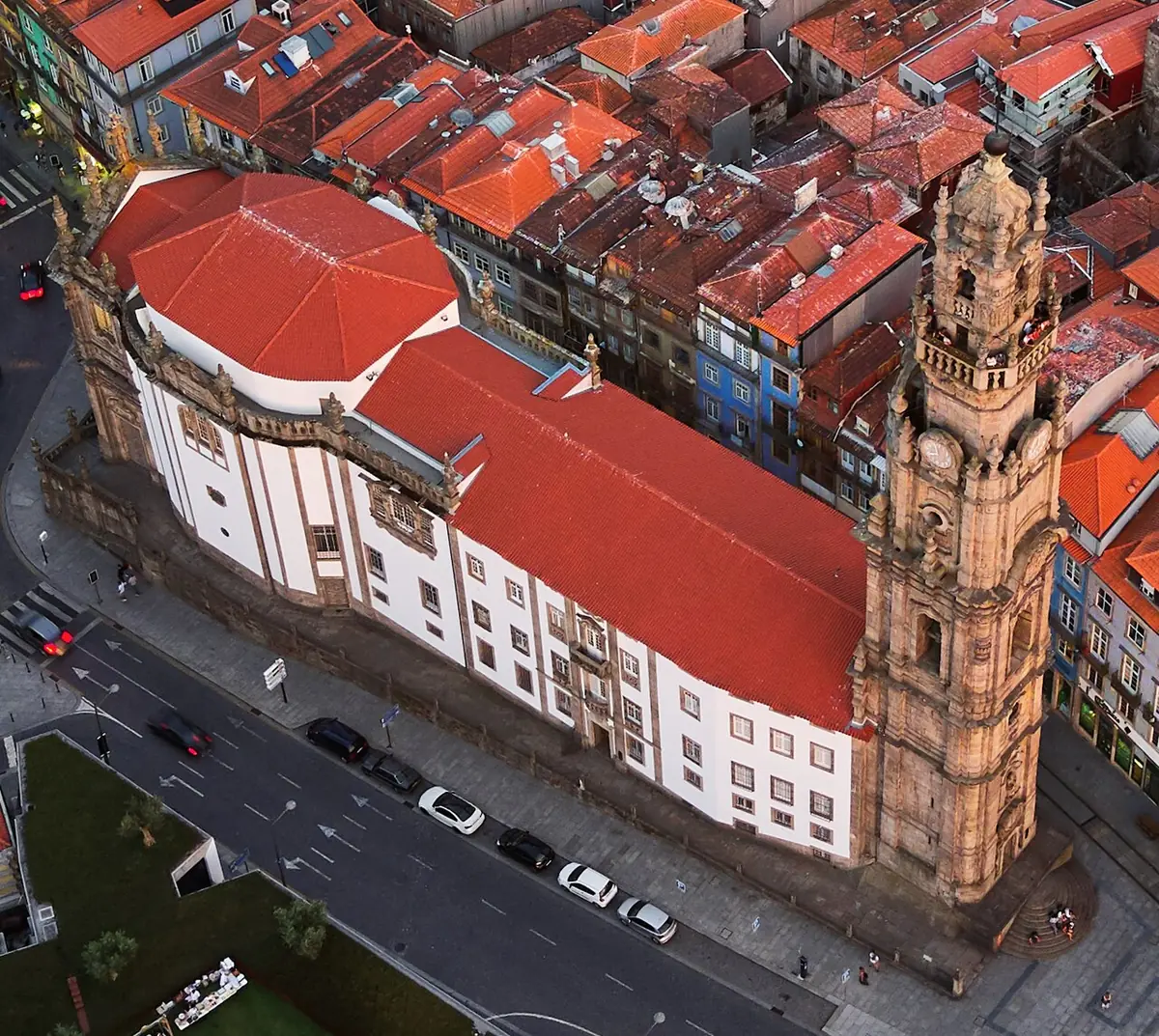
For the opposite approach, walk to the Igreja e Torre dos Clérigos, where the granite itself is the show. It is Porto's great late-Baroque ensemble, designed by Nicolau Nasoni, and its power comes from making the stone perform. Restless curves, recesses and projecting details turn hard local granite into something theatrical.
Notice how the church, the bell tower and the connecting Brotherhood House read as one long composition across a steep site. The church came first, built between 1732 and 1749; the Brotherhood House followed; the tower was finished in 1763. The narrow front is deliberately tall in effect, with a dramatic spread of carved decoration around it. Inside, the church has an oval single nave beneath a dome, rather than the long rectangular space you would expect.
_(cropped).jpg)
This was the home of a brotherhood formed to support secular clergy facing poverty, illness and death — an institution for looking after its own. Nasoni gave more than three decades to the project and was buried in this church; a crypt uncovered during recent restoration may hold his grave. The complex has been a National Monument since 1910, two years before the Carmo tiles went up.
That date ordering is the useful thing to carry away. When Clérigos was formally recognised as a monument, none of these three tile schemes existed yet: Carmo's came in 1912, the Chapel of Souls' in 1929 and Santo Ildefonso's in 1932.
Nasoni is also the thread that ties this stop back to the third. The same hand that shaped the Clérigos ensemble designed the principal altarpiece inside Santo Ildefonso — so at one of our tiled churches, the Nasoni interior and the twentieth-century exterior are by hands separated by the better part of two centuries, meeting on the same building without ever consulting one another. Walk in through Colaço's 1932 tiles and you arrive at Nasoni's altarpiece. Nobody planned that sequence; it simply accumulated.
It is worth resisting the obvious conclusion here, which is that the tiles are somehow inauthentic. They are not a tourist-era invention — 1912 and 1932 are not recent, and the workshops in Gaia and Lisbon that made the Carmo and Chapel of Souls tiles were doing serious industrial craft. The point is narrower than that, and more interesting: these surfaces have a date, an author and an intention, and all three are knowable. A wall that reads as anonymous and ancient turns out to have been designed by Silvestre Silvestri, painted by Carlos Branco, and produced in Vila Nova de Gaia, in 1912.
Walking the tiles
Take these four in sequence and the city rearranges itself. Carmo's carved front shows you the eighteenth-century church speaking for itself, and the tiled side wall shows you 1912's opinion of it. The Chapel of Souls shows the same operation applied to a chapel on Rua de Santa Catarina. Santo Ildefonso repeats it once more in 1932, over a granite church with a Nasoni altarpiece inside. And Clérigos stands as the control: the same period, the same city, the same architect moving between projects, with the granite itself doing the performing.
None of this makes the tiles less impressive — 15,947 pieces on one chapel is a serious industrial and artistic undertaking, and the Carmo tableau is genuinely remarkable. But it does change what you are looking at. These are not medieval surfaces. They are a modern argument about identity, made in ceramic, on buildings that were already old when the argument started.
It also gives you something to do with your eyes beyond photographing the obvious wall. Look for the seams between the centuries: the carved front and the tiled side wall at Carmo, the sliver of house wedged between two churches, the Nasoni altarpiece waiting behind Colaço's 1932 façade. The city is legible in layers once you know the layers are there.
Guided builds a walking route through Porto around your interests and the time you have, and narrates stops like these with GPS-triggered audio as you arrive, hands-free and fully offline once the tour is downloaded.
Places in this story
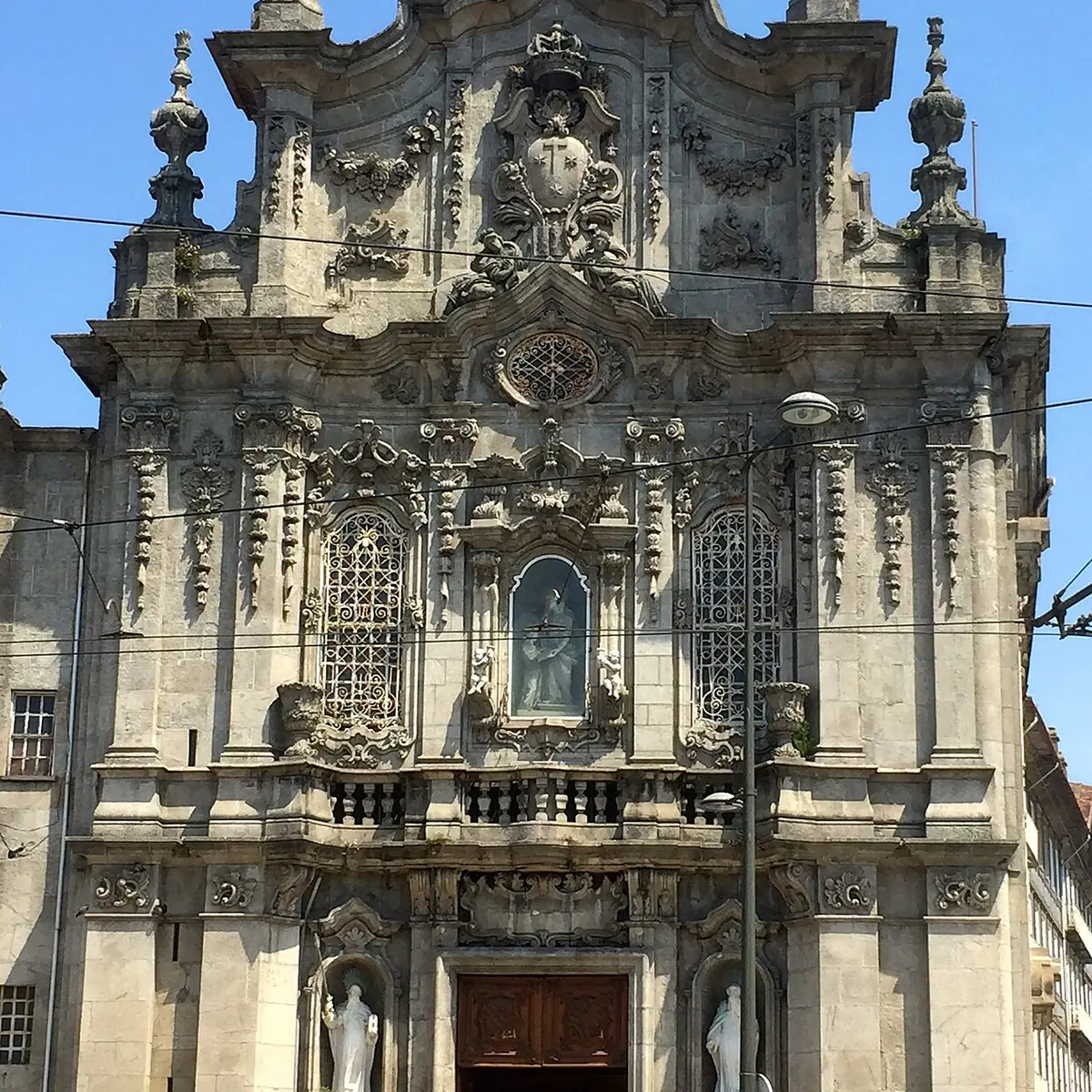
iXcia0069 (CC BY-SA 4.0) Igreja do Carmo
history
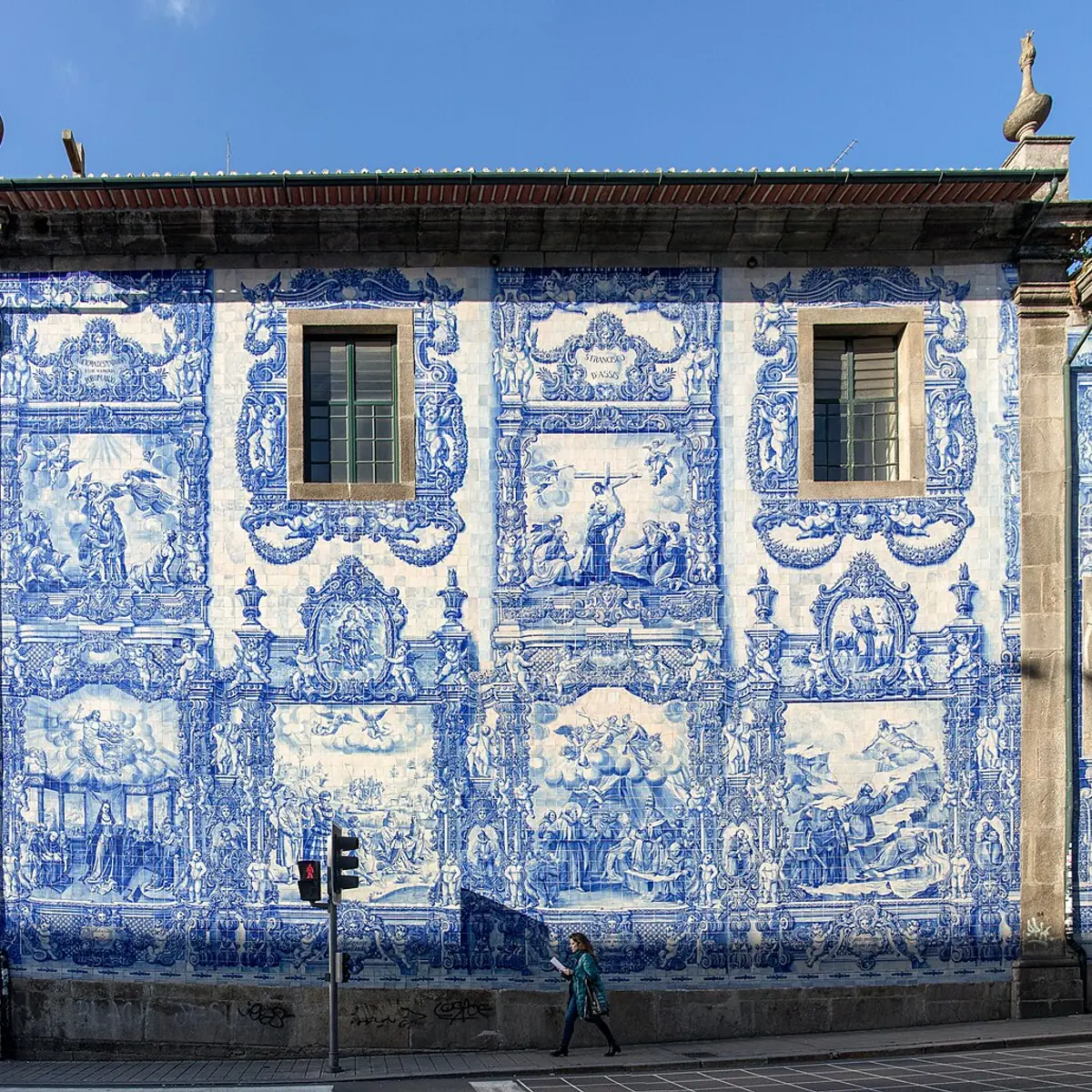
iRodrigo Tetsuo Argenton (CC BY-SA 4.0) Azulejos na Capela das almas
history
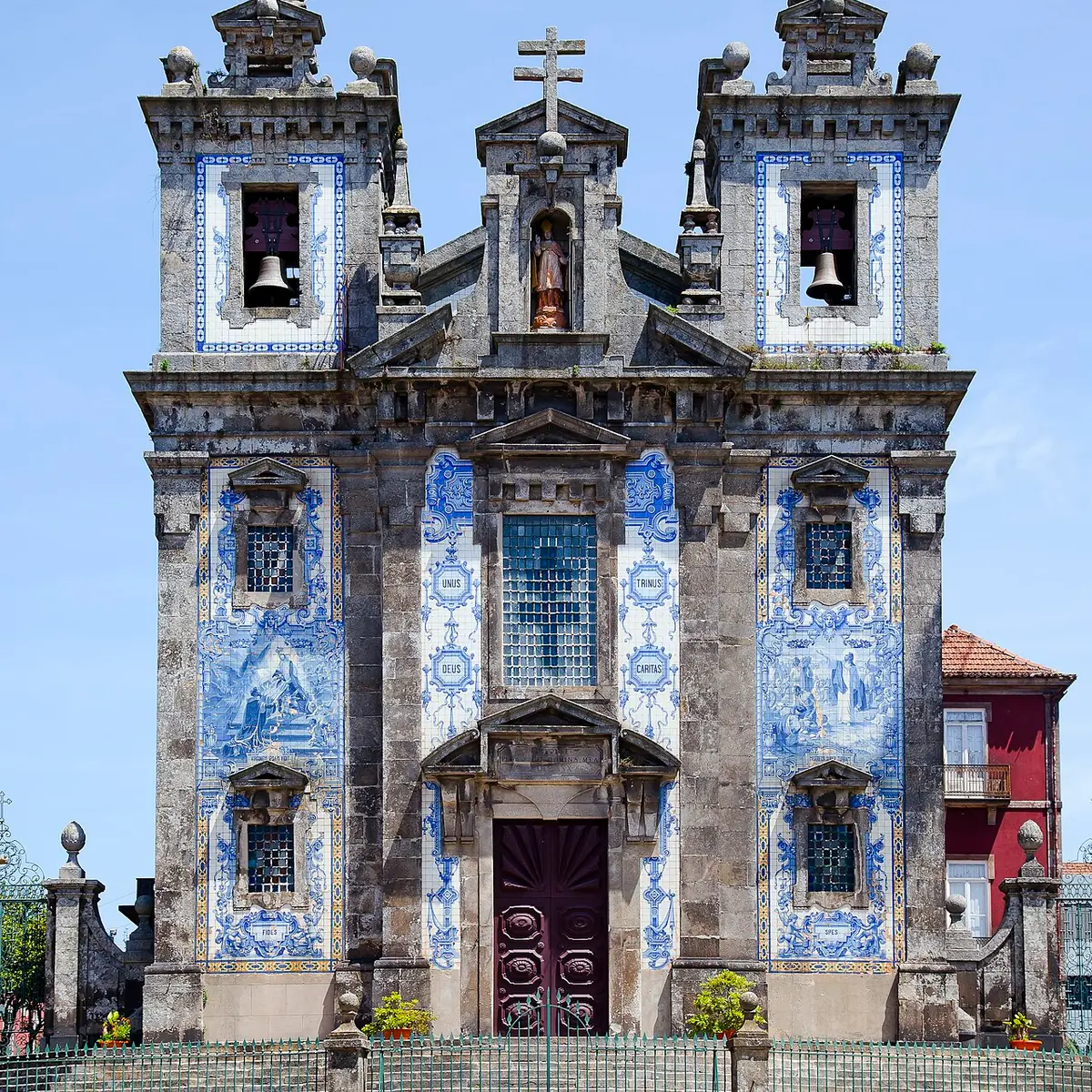
iDiego Delso (CC BY-SA 3.0) Igreja de Santo Ildefonso
history
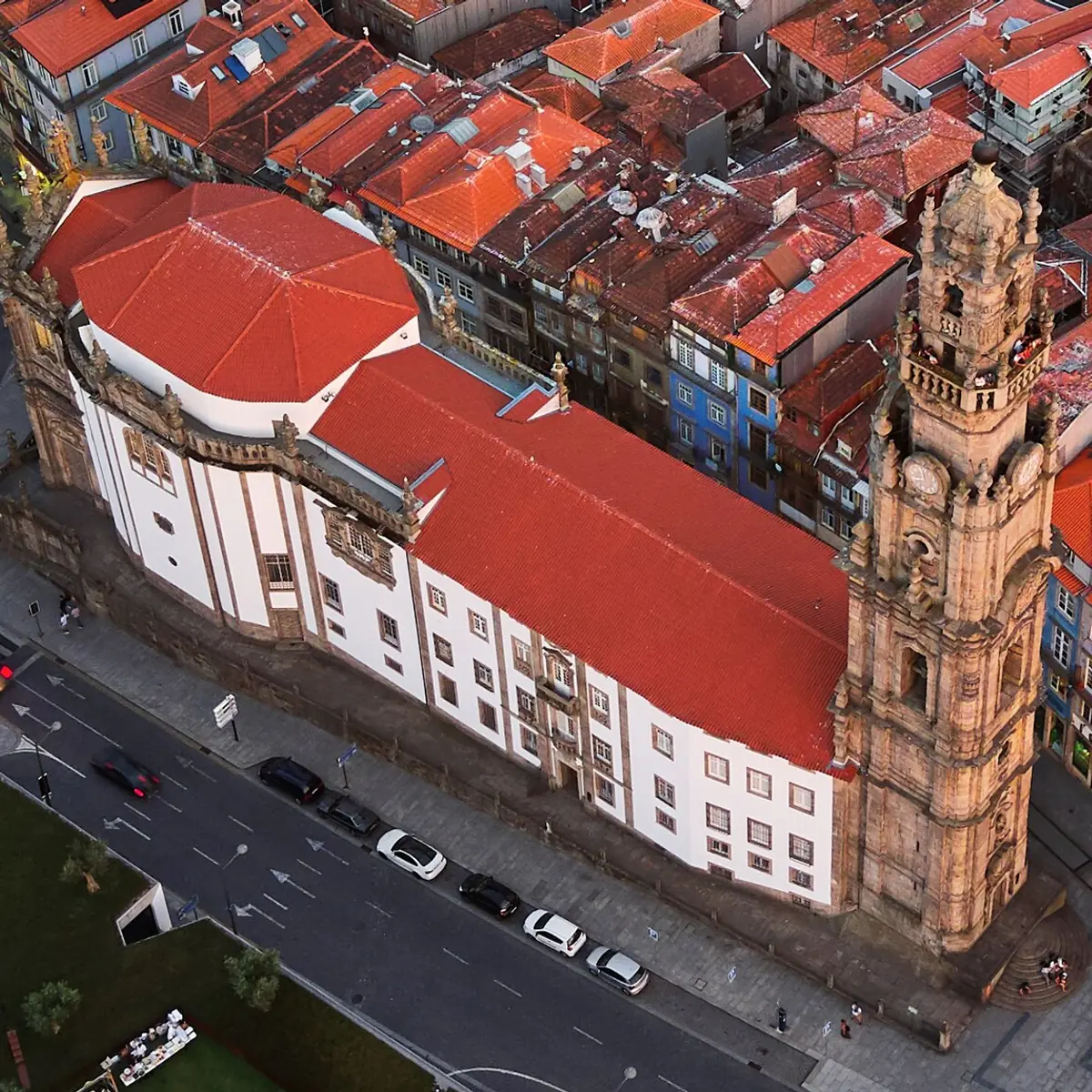
iDeensel (CC BY 2.0) Igreja e Torre dos Clérigos
history
Walk Porto with an audio guide in your pocket
Free during the beta — join, and this story becomes a route you can actually walk.
Get early access