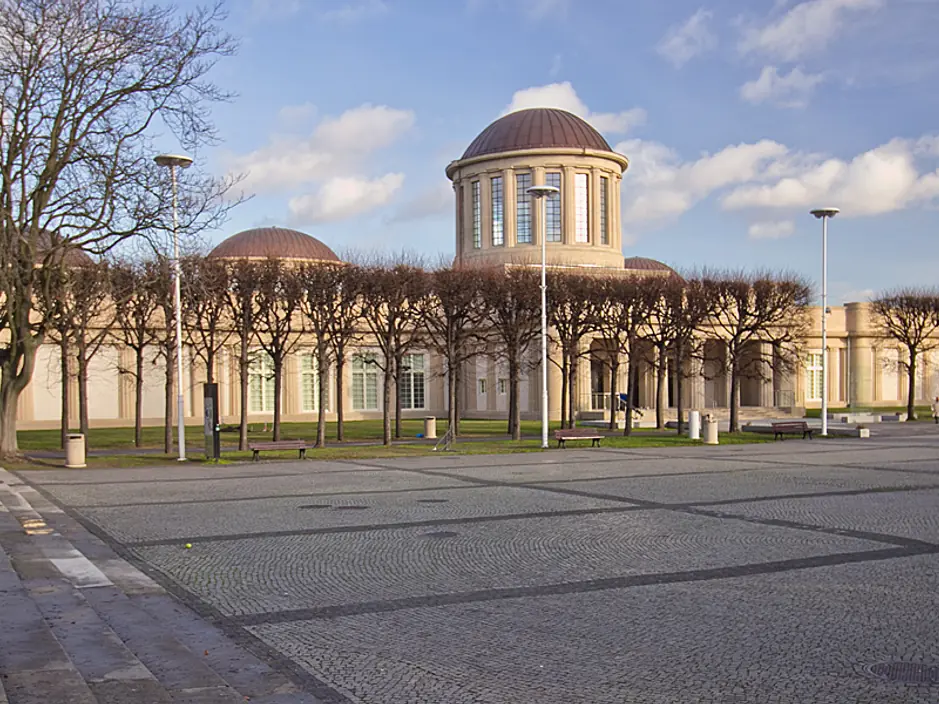
Few exhibition buildings have gone on to serve as both a planetarium and a film studio. Pawilon Czterech Kopuł was designed by Hans Poelzig in the expressionist style and completed in 1913. Built for the Centennial Exhibition, it formed part of this eastern Wrocław exhibition landscape alongside Centennial Hall, the Pergola, and the Japanese Garden.
Its first historical display filled 56 rooms and traced wars, battles, and significant figures, with a major section on Wrocław in the Napoleonic Wars. While you stand still on the pavement, notice how the low building spreads outward rather than rising like a conventional monument. Four wings enclose an inner court, each with a central dome; the east and west domes are round, while the north and south ones are oval.
The structure survived the Second World War. In 1951, one dome housed a Zeiss planetarium assembled from recovered observatory components; two years later, the building became the Wrocław Feature Film Studio. Since 2016, it has housed the Museum of Contemporary Art, part of the National Museum in Wrocław.
Inside are works including those by Magdalena Abakanowicz, Tadeusz Kantor, Katarzyna Kozyra, and Alina Szapocznikow. Since 2006, the pavilion and neighboring Centennial Hall have shared UNESCO World Heritage status.