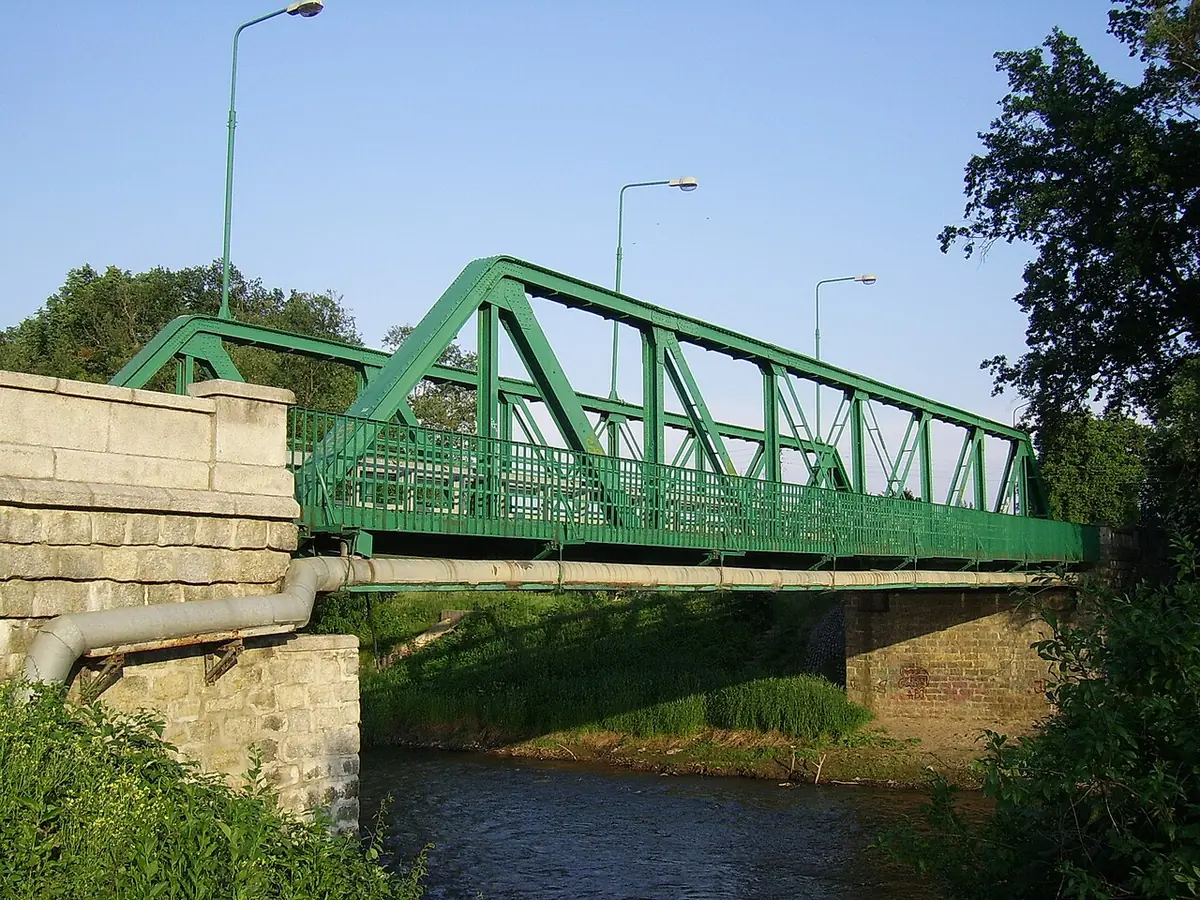
Built in 1900, Most Marszowicki is more than a simple crossing: its 35.4-metre span is carried by two riveted steel trusses. You are on Główna Street, where the bridge takes traffic over the Bystrzyca in western Wrocław. Marszowice occupies the river’s west bank, while Stabłowice begins on the east bank, so this short passage links two distinct neighbourhoods.
From a safe place on the pavement, notice the bridge’s practical, industrial shape. Its deck sits low within the truss structure, with a roadway between the steel sides and pedestrian space alongside. The whole bridge is 8.7 metres wide; most of that width belongs to the road, while each footway is just over a metre across.
There is more infrastructure nearby than the bridge alone suggests. Upstream stands the Marszowice water-control structure, accompanied by a small hydroelectric plant. The bridge, the riverside engineering works, and a boundary stone at the eastern end are all protected as city heritage. That modest stone marks how this crossing belongs not only to the street and river, but also to Wrocław’s recorded built landscape.