Rather than discarding prices, Oskar Lange designed a socialist economy that would use them as a planning instrument. He argued that planners could read shortages and unsold surpluses in stock levels, then alter official prices until production and demand moved back toward balance. His scheme became an early and influential model of market socialism, joining socialist ownership with tools usually associated with markets.
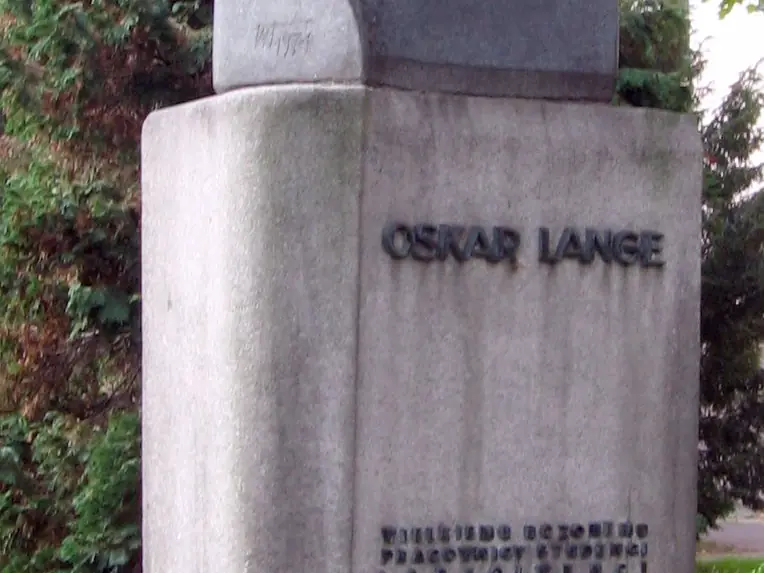
The bust in front of you brings that economist into the grounds of Wrocław University of Economics. It was unveiled on 2 October 1974, when the institution then known as the Academy of Economics took Lange’s name. Sculptor Władysław Tumkiewicz made the portrait in syenite, set it on a granite pedestal, with a wide single-step syenite platform and granite paving around it.
While standing here, you can make out the formal monument layout and the inscription naming Lange and honouring him from the academy’s staff, students, and graduates. Lange’s public life was as consequential as his theories: after working in the United States as an academic, he returned to Poland after the Second World War, served as Poland’s first ambassador to the United States, and later held senior office in socialist Poland. His association with the communist-era regime has made this monument controversial, though the university has declined to remove it.